Phone:
+86-2164856633
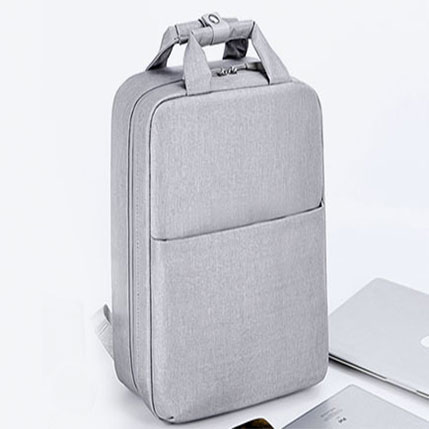
A reliable laptop bag manufacturer should do more than reproduce a design at an acceptable price. For custom business projects, the supplier needs to understand laptop protection, material selection, structural development, branding requirements, sampling, and bulk-production quality control.
Before placing an order, buyers should evaluate how the manufacturer develops the product, controls critical construction details, and keeps the approved sample consistent with mass production.
Custom laptop bag projects often involve more variables than standard promotional bags. The internal compartment has to fit the intended device, padding needs to provide practical protection without making the bag unnecessarily bulky, and the carrying structure must remain comfortable under daily loads.
A capable laptop bags supplier should therefore be able to work from a tech pack, reference sample, drawing, or initial concept and translate it into a manufacturable design.
During development, pay particular attention to the laptop compartment dimensions. A bag described simply as suitable for a "15.6-inch laptop" may not fit every device with the same screen size because actual laptop dimensions vary.
For projects targeting a specific electronics model or product range, providing physical device dimensions is more reliable than specifying screen size alone.
Protection is one of the clearest differences between an ordinary business bag and a properly designed laptop bag.
The laptop compartment should have enough padding to reduce everyday impact and prevent direct contact with harder accessories stored elsewhere in the bag. Its position also matters. A compartment that extends directly to the bottom of the bag may offer less protection when the bag is placed heavily on a hard surface.
Buyers should review the sample with actual use in mind. Check whether the laptop moves excessively inside the compartment, whether zipper hardware could contact the device, and whether the structure remains stable when the bag is fully loaded.
These details are more useful for evaluating computer bag manufacturers than judging the product only by its exterior appearance.
There is no single best material for every laptop bag.
Polyester and nylon fabrics are widely used for business and travel collections because different fabric constructions can provide a practical balance between weight, durability, appearance, and cost. Canvas, PU, recycled fabrics, and other materials may also be suitable depending on the target market.
What matters is whether the supplier can explain why a particular material specification is appropriate for the project.
For corporate programs, the priority may be consistent branding and cost control. Retail products may require a more distinctive hand feel and finishing quality, while commuter or travel bags often need greater attention to abrasion resistance and weather protection.
Ask for actual material swatches before final approval whenever fabric texture, color, or finish is important.
A sample should be treated as the production benchmark rather than simply a visual preview.
Test it with the intended laptop and the other items users are likely to carry. Open and close the zippers repeatedly, load the main compartment, carry the bag by both the handle and shoulder strap, and check how the structure changes under weight.
Pay particular attention to high-stress areas around handles, shoulder strap attachments, zipper ends, and the bottom of the bag. Uneven stitching or insufficient reinforcement in these areas can become more noticeable after regular use.
Branding should also be approved at this stage. Logo dimensions, placement, color, embroidery density, printing effect, labels, and packaging requirements should all be confirmed before bulk production.
Quality control should happen throughout production rather than only before shipment.
Incoming fabrics and accessories need to match the approved specification. During sewing, the manufacturer should monitor dimensions, stitching, reinforcement points, logo placement, and overall construction. Finished products should then be checked for appearance, functionality, workmanship, and packing accuracy.
For larger custom orders, buyers should establish an approved sample and written specifications that can be used as a common reference during inspection.
This becomes particularly important for repeat orders. A reliable laptop bag manufacturer should be able to reproduce the agreed construction without noticeable changes in fabric, padding, color, hardware, or workmanship from one production batch to another.
A lower quotation is not necessarily a lower project cost.
Differences in fabric specification, padding, zipper quality, reinforcement, packaging, inspection standards, and customization can all affect the quotation. Comparing prices without confirming these details can result in two apparently similar laptop bags being built to very different standards.
When selecting a laptop bags supplier, evaluate how clearly the company communicates about specifications, sampling, production changes, and quality issues. Fast responses are useful, but accurate responses that prevent mistakes during production are more valuable for long-term projects.
A supplier that can identify potential construction or material problems before mass production can reduce expensive revisions later.
Choosing the right manufacturer for a custom laptop bag project requires more than comparing catalogs and quotations. Product development capability, laptop protection design, material knowledge, sampling accuracy, production consistency, and quality control all influence the final result.
For brands, distributors, corporate programs, and retailers, the most reliable approach is to define the product requirements clearly and use the approved sample as the standard for bulk production. This makes it easier to compare computer bag manufacturers on actual manufacturing capability rather than price alone.
Provide the bag size, laptop dimensions, preferred materials, design reference, logo requirements, quantity, packaging needs, and target market.
Yes. Materials, dimensions, compartments, padding, colors, accessories, logos, labels, and packaging can usually be customized according to the project.
Test the sample with the intended device and check compartment fit, padding, bottom protection, zipper position, and structural stability.
Yes. The approved sample should serve as the main reference for materials, construction, dimensions, branding, and workmanship.
Compare product development capability, specifications, sample quality, quality-control procedures, communication, production consistency, and total cost—not only the unit price.
NEXT

 English