Phone:
+86-2164856633
A plastic bottle can become part of a durable pencil case after collection, sorting, cleaning, recycling, fiber production, fabric manufacturing, and final bag assembly. The result is not simply a conventional pencil case with a different label. Material traceability, fabric construction, accessories, printing, and manufacturing quality all determine whether a pencil case from recycled materials performs well in daily use.
For stationery brands and wholesale buyers, understanding this process makes it easier to verify recycled-content claims and select the right material for a specific product.
The process begins with PET waste being collected and separated from unsuitable materials. After cleaning and preparation, the PET is recycled and converted into material suitable for producing polyester fiber and yarn.
That yarn can then be woven into RPET fabrics with different weights, textures, and constructions. Textile Exchange defines recycled polyester as polyester created from polyester-based sources through mechanical or chemical recycling, with the goal of producing material that performs as closely as possible to virgin polyester.
For pencil cases, this means manufacturers are not restricted to one standard fabric. RPET can be developed into different constructions according to the required appearance, durability, printing effect, and price point.
Once the RPET fabric is approved, manufacturing follows many of the same technical stages used for conventional textile pencil cases.
The fabric is inspected for color, surface defects, printing quality, and consistency before cutting. Individual panels are then cut according to the product pattern and combined with zippers, lining, webbing, labels, or internal organizers where required.
Sewing quality remains critical. A recycled material pencil case still needs stable seams, clean zipper installation, accurate dimensions, and sufficient reinforcement around frequently stressed areas.
This is an important point for buyers: recycled material should not be treated as a substitute for product engineering. Sustainability claims may attract attention, but poor construction will shorten product life and reduce the practical value of the material choice.
In most cases, RPET does not significantly restrict common pencil case designs.
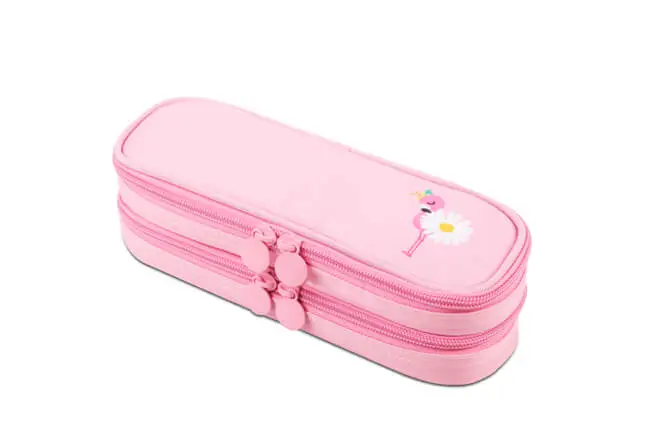
Flat pouches, rectangular cases, tube-shaped cases, multi-compartment designs, and printed school pencil cases can all be developed using appropriate recycled polyester fabrics. GOX, for example, currently applies RPET to several pencil case structures and printed designs.
The more important question is whether the selected fabric works with the intended construction.
A soft lightweight pouch may need a different fabric specification from a structured pencil case designed to hold a larger stationery set. Printing method, lining, padding, and internal organization also need to be considered during material selection.
For custom projects, buyers should approve the actual fabric and finished sample rather than relying only on a material description such as "recycled polyester."
Not necessarily.
A product described as a pencil case recycled materials design may use recycled polyester for the main outer fabric while components such as zippers, thread, lining, labels, foam, or reinforcement materials have different compositions.
This distinction matters when brands want to make specific recycled-content claims.
Buyers should therefore ask suppliers to clarify which components contain recycled material and what percentage or certification documentation can be supported. Avoid assuming that the recycled composition of the main fabric automatically applies to the entire finished product.
Documentation and supply-chain traceability are more reliable than visual inspection.
RPET usually looks and feels similar to conventional polyester, so a buyer generally cannot determine recycled content simply by examining the finished pencil case.
Standards such as the Global Recycled Standard (GRS) and Recycled Claim Standard (RCS) are designed to support verification and traceability of recycled materials through the supply chain. Textile Exchange also notes that auditing and certification are performed by independent certification bodies.
For larger wholesale or branded programs, buyers should discuss certification requirements before sampling. This helps ensure that the chosen fabric and production route can support the sustainability claims planned for packaging, marketing, or retail programs.
Not inherently.
The performance of a pencil case depends on the quality of the recycled yarn, fabric construction, stitching, zipper quality, reinforcement, and overall product design.
A well-developed pencil case from recycled materials should still be evaluated through normal product-quality criteria such as seam stability, zipper performance, abrasion resistance, colorfastness, dimensional accuracy, and workmanship.
For school stationery especially, durability matters because pencil cases are opened, closed, carried, compressed inside backpacks, and handled repeatedly throughout the day.
Choosing recycled material therefore should not mean lowering the functional standard of the finished product.
Before approving bulk production, buyers should confirm the exact recycled material specification, product dimensions, color or printing standard, zipper and accessory requirements, logo application, packaging, and inspection criteria.
For sustainability-focused collections, the recycled-content scope and required certification documents should also be agreed in advance.
This prevents a common sourcing problem: approving a visually attractive sample first and only discussing recycled-content documentation after production planning has already started.
The more clearly these requirements are defined during development, the easier it is to maintain consistency when the order moves into mass production.
Turning discarded PET bottles into stationery products involves much more than simply replacing one fabric with another. Recycling, yarn production, fabric development, product construction, and quality control all contribute to the final performance of a recycled material pencil case.
For brands and wholesale buyers, the best results come from balancing verified recycled content with practical requirements such as durability, appearance, customization, and production consistency.
GOX offers recycled pencil case options using RPET and other sustainable material choices for customized stationery projects, allowing buyers to develop products around both functional requirements and sustainability goals.
It is typically made using recycled polyester fabric produced from recycled PET sources such as plastic bottles.
Yes. Suitable RPET fabrics can support different colors, patterns, logos, and printing methods.
It can provide comparable practical performance when the yarn, fabric construction, and manufacturing quality are properly controlled.
Not always. The outer fabric may be recycled while zippers, lining, thread, or other components use different materials.
Request material specifications and applicable traceability or certification documentation from the supplier before bulk production.

 English